
Drilling Fluid Additive
Onshore and offshore oil and gas producers rely on custom-formulated calcium chloride brine fluids to prevent the absorption of water by shales in all types of drilling and completion applications.


Where To Use
Onshore and offshore oil and gas producers rely on custom-formulated clear brine fluids containing calcium chloride. These fluids, used in all types of drilling and completion applications, reduce water activity and, create osmotic forces to prevent shales from absorbing water in oilfield completion and workover operations. The brine’s divalent calcium ion inhibits clay swelling, dispersion, and migration. Water containing high concentrations of calcium chloride can be used as a kill fluid in production wells, especially those containing heavy concentrations of carbon dioxide.
Recommended Products
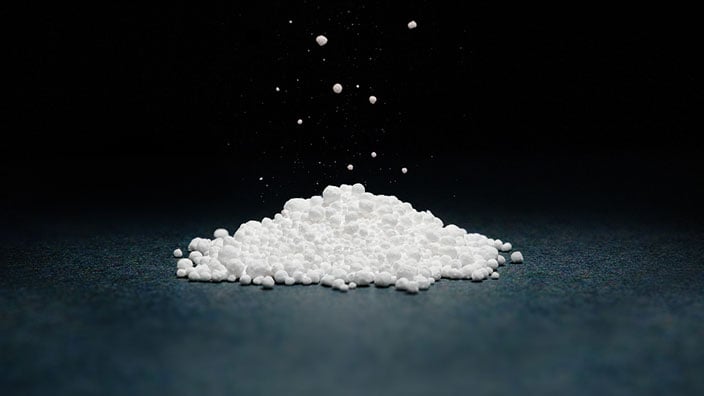
Anhydrous Calcium Chloride 94-97% Mini-Pellets
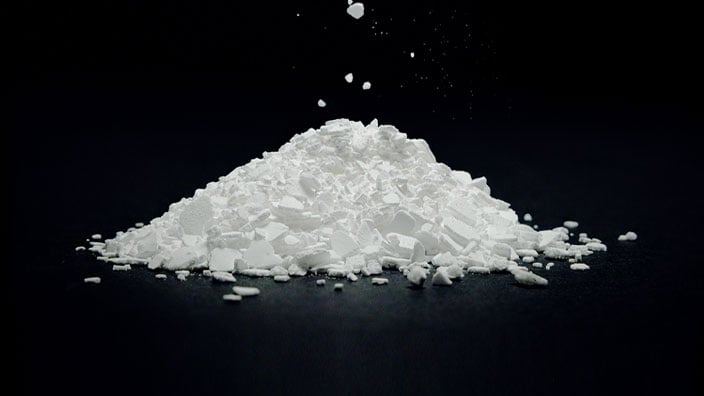
DOWFLAKE® Xtra 83-87% Calcium Chloride Flakes
LIQUIDOW® Technical Grade Calcium Chloride Solution
Drilling Fluid Additive FAQs
First, determine the amount of dry calcium chloride to mix with water using our helpful Making Solutions Calculator tool.
Always start with cool water and add the solid calcium chloride slowly to the water while continuously mixing. Significant heat is released when dissolving solid calcium chloride, and a temperature increase will occur. For example, when dissolving DOWFLAKE® Xtra 83-87% Calcium Chloride Flakes while making up a 30% solution, the temperature can be expected to increase almost 84°F.
If solids are allowed to sit motionless while in contact with water, a hard cake will form that will be slow to dissolve.
Please consult our Diluting Solutions Calculator, which covers three different options:
- Diluting with water
- Diluting with a lower concentration calcium chloride solution
- Diluting with both water and a lower concentration calcium chloride solution
The pH reading for an undiluted sample of 35% solution is approximately 9. OxyChem calcium chloride products are alkaline due to the presence of a slight calcium hydroxide impurity.
Accurate and consistent pH measurement in concentrated salt solutions can be challenging. Results vary depending on the pH probe used and the degree of sample dilution.
Store product in a dry area, and tightly reseal after each use. To maintain product quality while in storage, solid calcium chloride must be protected from moisture. If the product is on a pallet covered by an intact plastic shroud, it can be stored outdoors on a well-drained surface. If the shroud is torn, pierced, or removed, the palletized product should be stored indoors or under a waterproof covering.
For additional information, see our Calcium Chloride Handbook.
The preferred material of construction for large liquid storage tanks is carbon steel with an epoxy-based interior coating and a durable, high-quality coating on the exterior. Non-metallic materials, such as fiberglass or plastic, work well for smaller tanks storing product at ambient temperature; however, these materials are not as durable as carbon steel, and they lose strength at high temperature.
Common stainless steels are not recommended for liquid calcium chloride storage as they are subject to chloride stress corrosion cracking, even at temperatures as low as 100°F (38°C).
For additional information, see our Calcium Chloride Handbook.
When properly stored to protect from moisture contact, the expected shelf life for solid calcium chloride products is 36 months from the date of manufacture. Calcium chloride does not degrade or deteriorate; however, the shelf life is limited based on the potential for moisture intrusion into the product, which may cause product clumping. Solid calcium chloride absorbs moisture from the air (i.e., is hygroscopic), even to the point of converting to liquid brine (i.e., is deliquescent).